

What Is an AI Model, Actually? (Explained Without the Jargon)
If you've ever downloaded or heard about an "AI model" — like the ones behind ChatGPT, Llama, or Mistral — you might picture something like a computer program. Something with code, instructions, maybe even a little bit of "thinking" logic baked in.
It's not that at all.
An AI model, sitting on a hard drive, is basically just... numbers. Billions of them. No instructions, no "if this, then that" logic, nothing that looks like a traditional computer program. It's closer to an enormous spreadsheet than it is to software.
Let's unpack what that actually means, using a simple analogy to keep things grounded.
PS: This is an excerpt from my Master AI course which I will be delivering live on YouTube from September 12, at 8PM EAT. The classes will be live every Saturday at the same time.
Think of a Model Like a Giant Dial Board
Imagine a massive wall covered in millions of tiny dials. Each dial can be turned to a specific number. During "training," an AI company spends months adjusting every single dial — sometimes billions of them — until the whole wall, working together, can do something useful: write text, answer questions, recognize images.
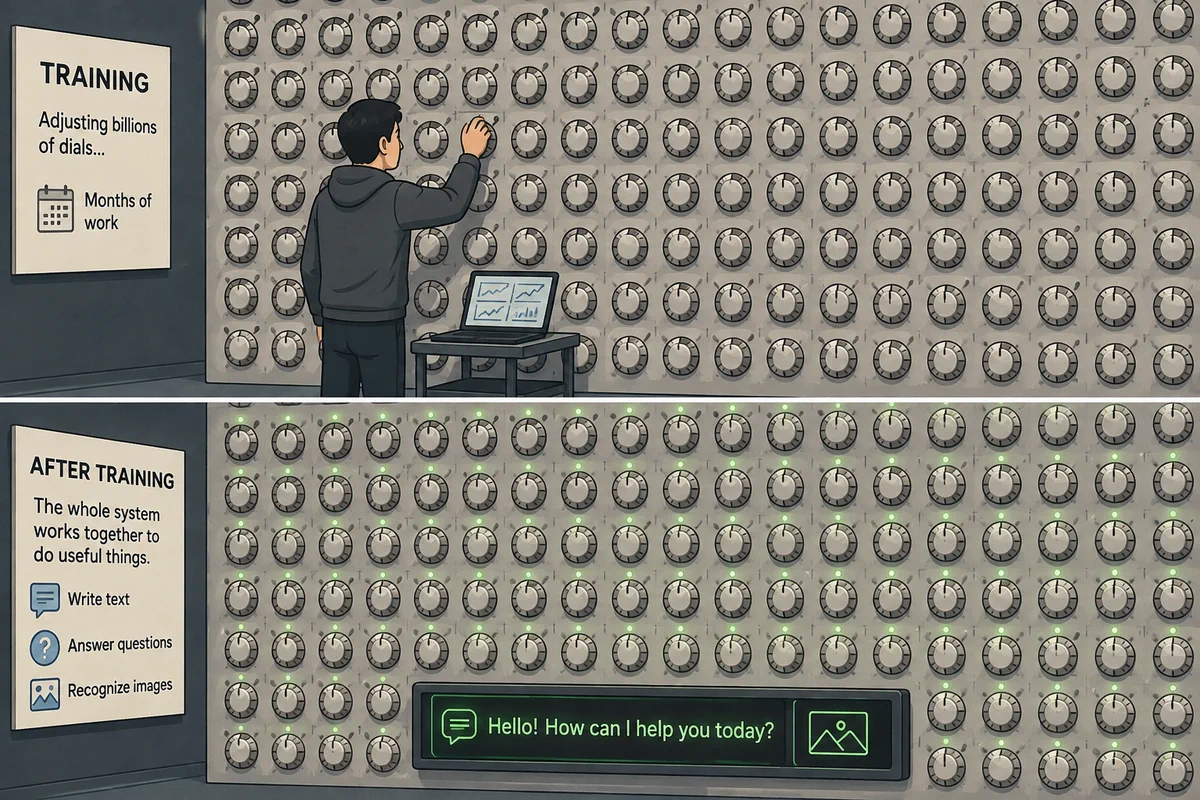
Once training is done, those dial settings get saved to a file. That file — the "model" — is nothing more than a giant list of what each dial is set to. It doesn't do anything by itself. It's just a record of settings. You need a separate piece of software to actually read those settings and use them to generate answers.
Those dial settings have a technical name: weights. When people say a model has "7 billion parameters," they mean it has 7...
Loading comments...
Related Stories
Explore More Topics
No topics available at the moment