
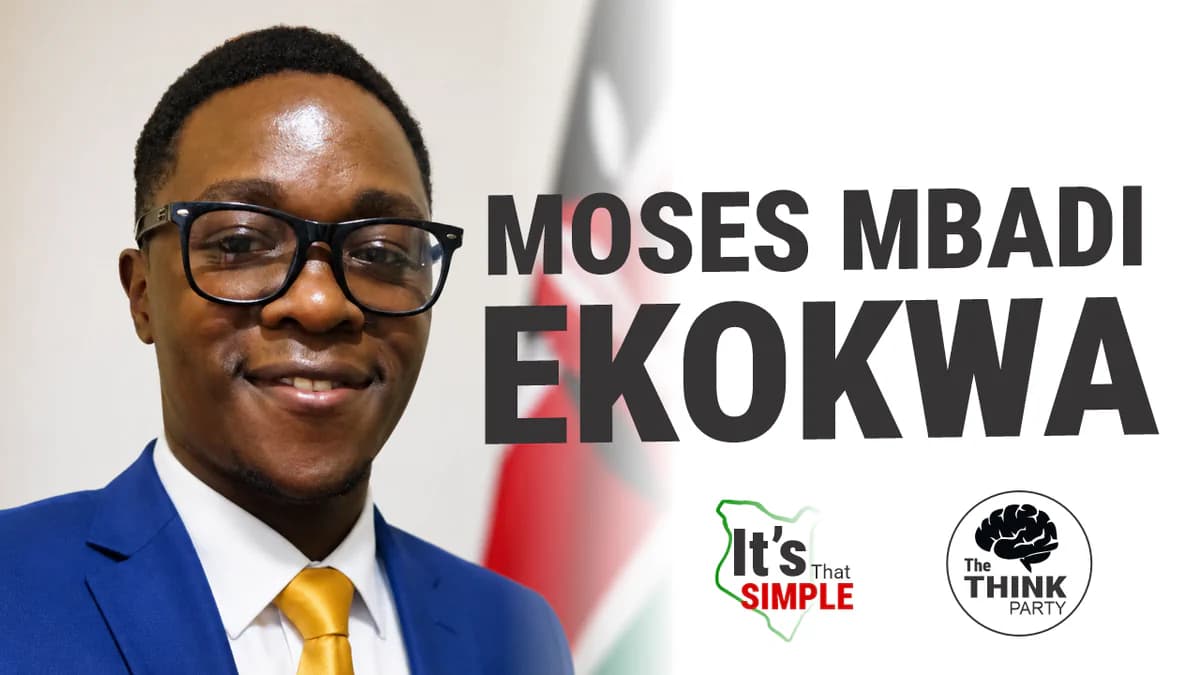
I will Run for Presidency, here is my manifesto
It's That Simple
By Moses Mbadi | Software Engineer, Kenyan Citizen, Candidate for President
I am 32 years old. I have spent my career building systems — systems that handle real users, real data, real failures, and real consequences. I know what it means to ship something that works. I know what it means to be accountable when it doesn't. I am running for President of because I am tired of watching a country with every ingredient for greatness be run like a system nobody is responsible for maintaining.
This is not a manifesto of promises. It is a blueprint — specific, costed, and measurable. If I do not deliver it, you will have the receipts.
The Diagnosis: We Are Not Poor. We Are Mismanaged.
Kenya is not a poor country. We have talented people, arable land, a strategic geography, a young population, and decades of international goodwill. What we have failed to build is a government that functions like a competent institution rather than a patronage network.
Every Kenyan knows the symptoms:
- A graduate with a first-class degree driving a boda boda because there are no jobs
- A mother who sells land to pay for surgery that should be covered by a public hospital
- A student in a school with 80 children per classroom and no textbooks
- A road that gets "repaired" every year with the same contractor and the same potholes
- A government official earning Ksh 1.2 million a month to attend committees that produce no outcomes
This is not bad luck. This is the predictable output of a badly designed system run by people who benefit from its dysfunction.
I intend to redesign the system.
Principle One: Government is a Service, Not a Reward
The first thing I will do as President is end the culture of government as a trophy.
Public office is a service contract. You are hired by taxpayers. You are paid by taxpayers. You are accountable to taxpayers. If you cannot demonstrate output, you are replaced.
What this means in practice:
Salary and Benefits Reform — In the First 100 Days
The President's salary will be reduced by 40% and pegged to a transparent formula: a fixed multiple of the median Kenyan wage. As the median wage rises, so does mine. My incentive is now mathematically aligned with yours.
Cabinet ministers, MPs, and senators will have their salaries capped at 25 times the national minimum wage. All non-essential allowances — sitting allowances, mileage claims, committee fees — will be eliminated and replaced with a single consolidated compensation package.
The total wage bill for the executive and legislature will be published monthly, in a public dashboard, broken down by individual. Every Kenyan will be able to see, on their phone, exactly what their representatives are being paid.
Performance Contracting That Has Teeth
Every Cabinet Secretary will sign a public performance contract within 60 days of appointment. The contract will specify 5 to 8 measurable targets for their ministry over 12 months. At the end of the year, performance against those targets will be independently audited and published. Three consecutive quarters of failure to meet targets triggers a mandatory parliamentary review. I will not protect underperforming appointees because of political loyalty.
Principle Two: Fix the Economy by Fixing the Ground It Grows On
I am not an economist. I am an engineer. Engineers do not theorize about systems — they identify bottlenecks and remove them. Kenya's economy has clear, identifiable bottlenecks.
Unemployment: The Real Crisis
Youth unemployment in Kenya is not a skills problem. It is a demand problem, a trust problem, and a cost-of-doing-business problem. Brilliant Kenyans are unemployed not because they lack ability, but because the environment in which they would create or find work is hostile.
Removing the friction from starting a business:
Currently, registering a business in Kenya involves multiple agencies, arbitrary timelines, and a network of informal fees. My administration will consolidate all business registration into a single digital platform, with a guaranteed 48-hour turnaround, a fixed transparent fee, and zero in-person requirements. We will benchmark ourselves against Estonia, which registers businesses in 18 minutes.
Public procurement for Kenyan businesses:
The government spends billions annually. Too much of that money leaves Kenya. My administration will implement a mandatory local content policy: any government contract under Ksh 50 million must be awarded to a Kenyan-owned company, provided they meet technical requirements. Larger contracts must demonstrate at least 40% Kenyan subcontracting. This is not protectionism — it is economic engineering.
MSME Credit Access:
The single biggest killer of small Kenyan businesses is cash flow, not ideas. We will establish a government-backed MSME credit facility offering collateral-free loans of up to Ksh 500,000 at a fixed 8% annual rate, disbursed entirely digitally, with repayments tied to mobile money receipts. No office visits. No guarantors. No brokers.
A Technology-First Jobs Strategy:
Kenya has a genuine competitive advantage in technology. Safaricom's M-Pesa, built on Kenyan soil, is studied at Harvard. We will invest in this advantage deliberately. My administration will create 50 digital skills hubs in every county within three years — not computer labs that collect dust, but working environments with reliable internet, industry mentors, and direct pipelines to remote work platforms and local employers. The target: 200,000 trained and employed technology workers within five years.
Principle Three: Healthcare as a Non-Negotiable Right
A country that lets its people die from preventable illness because they cannot afford treatment is a country that has failed its most basic function.
The current state of Kenyan public healthcare is a scandal. Hospitals without drugs. Equipment that was procured and never installed. Doctors who are paid late. Patients who are turned away or expected to buy their own gloves.
This is not a resource problem. Kenya spends money on health. The money disappears.
What I will do:
Full digital tracking of medical supplies:
Every drug and piece of equipment procured with public funds will be tracked from procurement to point of care on a public ledger. Diversion of medical supplies will be treated as a criminal offense equivalent to manslaughter, because that is what it is. The first prosecution under this framework will set the tone.
Rebuild the community health infrastructure:
We will hire and properly pay 50,000 community health promoters — people in every village who are trained to do basic screening, maternal care follow-up, vaccination reminders, and chronic disease monitoring. This is the most cost-effective healthcare intervention in the public health literature. Rwanda has done it. We will do it better.
NHIF restructured into a functional universal scheme:
The National Health Insurance Fund will be restructured. Its governance will be overhauled, its management replaced, and its benefit package redesigned so that any Kenyan who walks into a public facility for primary or secondary care pays nothing out of pocket. The fund will be audited quarterly by an independent body whose reports are published within 14 days of completion.
Maternal and child health:
Kenya's maternal mortality rate is an embarrassment we have normalized. Every public facility that handles deliveries will meet minimum staffing and supply standards within 18 months or its management will be replaced. I will personally track this number quarterly. It will fall.
Principle Four: Education That Produces Citizens, Not Certificates
We have put millions of children through school and produced a generation that can pass exams but cannot find work, think critically, or build anything. This is a curriculum failure, a teacher motivation failure, and an infrastructure failure happening simultaneously.
The changes:
Teachers must be paid on time, every time:
This is not a policy. It is basic decency. Teacher salaries will be placed on an automated payment system that cannot be delayed by bureaucracy or political interference. Any county government that fails to process teacher payments on time will face automatic budget penalties.
Curriculum reform aligned with the real world:
The CBC curriculum has the right instincts but a deeply broken implementation. We will bring together teachers, employers, and education researchers to complete the curriculum revision with clear milestones. Every child will leave primary school able to read, do arithmetic, and use a computer. These are not aspirations —...
Loading comments...
Related Stories
Explore More Topics
No topics available at the moment