
Building Kenya's National Digital Talent Identification Platform
How technology, nationwide training, and structured scouting are helping transform football development in Kenya.
“Every great football nation begins by finding its next generation before anyone else does.”
Across Kenya, thousands of talented boys and girls play football every day on dusty pitches, school grounds, and community fields. Many possess extraordinary potential, yet for decades, countless gifted players have remained undiscovered — not because they lacked ability, but because there was no structured system to identify, document, and develop them.
The Football Kenya Federation (FKF), through the FIFA Talent Development Scheme (TDS), set out to change this narrative.
The vision was ambitious: create a sustainable nationwide talent identification system capable of reaching every region of the country, ensuring that geography would no longer determine whether a young footballer had an opportunity to be seen.
Achieving this required much more than organizing scouting events. It demanded a standardized scouting methodology, trained personnel, reliable data collection, and a digital infrastructure capable of supporting football development at a national scale.
As part of this initiative, I had the opportunity to design, develop, deploy, and support the Talent Identification Platform that now powers the programme’s digital operations.

A National Vision
As FKF Football Development Director Coach Francis Kimanzi aptly states,
“This programme is about creating opportunities for every talented young footballer in Kenya, regardless of where they come from.”
For many years, talented players in remote parts of the country simply have gone unnoticed because structured scouting systems did not exist.
The FIFA Talent Development Scheme seeks to address this challenge by helping member associations establish sustainable systems for talent identification and player development.
For Kenya, this meant creating a framework that would:
- identify talented players at an early age;
- standardize how scouts evaluate players;
- establish a national football talent database;
- strengthen player development pathways;
- provide data to support regional planning and future national team selection.
Technology would become the backbone that connected all these moving parts.

Building the Human Infrastructure
Before developing the platform, the priority was building the people who would use it.
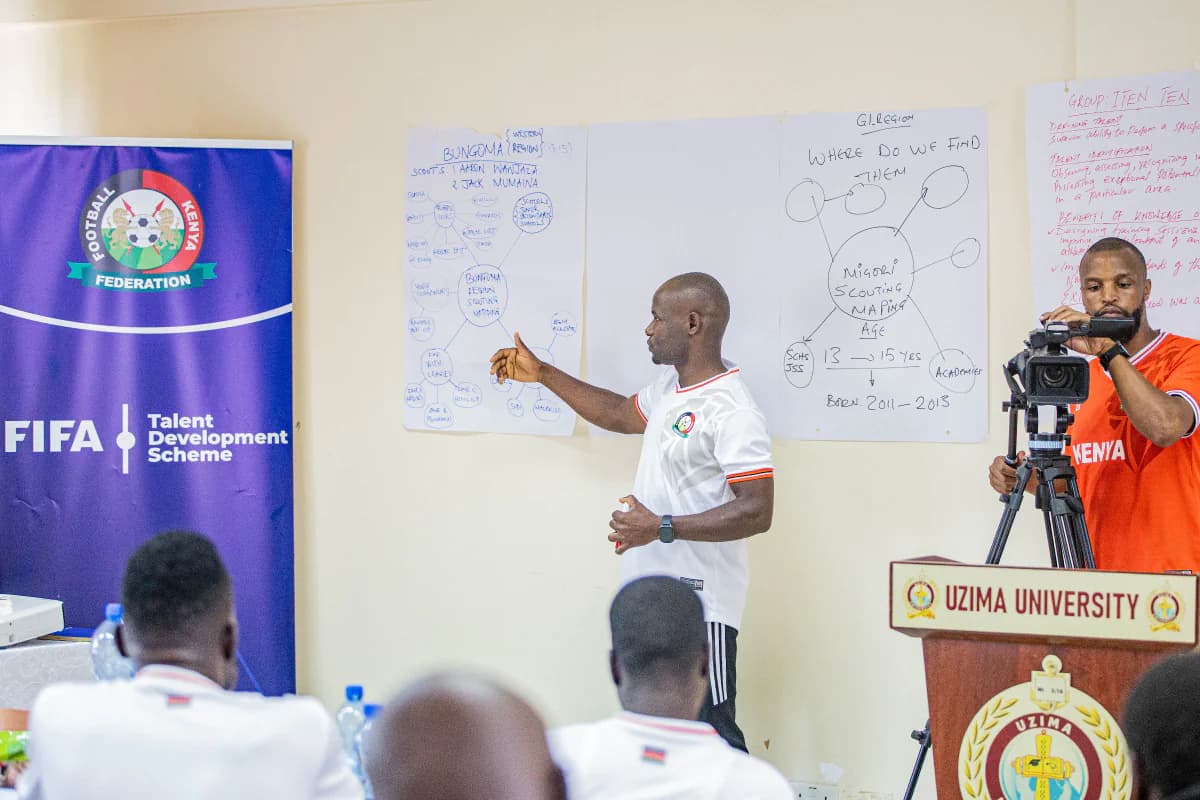
FKF organized nationwide scout training programmes covering every football region in Kenya.
By the conclusion of the exercise:
- 90 scouts had been accredited.
- 86 scouts were actively deployed across the country.
- Every football region had trained personnel capable of conducting standardized assessments using FIFA Talent Development criteria.
These weren’t simply software training sessions.
Scouts were trained on:
- player observation techniques;
- standardized evaluation criteria;
- objective reporting;
- identifying long-term potential rather than immediate performance;
- digital reporting using the Talent Identification Platform.
This created a common language for talent identification nationwide.

Turning Paper into Data
One of the project’s biggest challenges was replacing fragmented paper records with a centralized digital system.
Historically, scouting reports often remained within individual regions.
Player information was difficult to retrieve.
Historical records were inconsistent.
Comparing talent across different parts of the country was almost impossible.
The new platform changed that.
Every player entered into the system becomes part of a centralized national database.
Regional administrators can review submissions, validate player records, monitor scouting activity, and generate reports in real time.
Instead of waiting weeks or months for paper reports, football administrators can instantly understand how talent identification is progressing throughout the country.
Early Results
The impact became visible almost immediately.
Within the first months of implementation:
- 600+ players had already been identified and profiled.
- The database continued growing daily.
- 257 players had already been classified as top talents.
- Hundreds more had been identified as high-potential prospects requiring continued monitoring.
The regional distribution demonstrated that talent exists throughout Kenya.
Rather than concentrating only on traditional football strongholds, the programme successfully reached communities across the country, ensuring young players from every region had an opportunity to be discovered.
Today, the platform continues to grow and has surpassed 800 registered grassroots players, creating one of Kenya’s most comprehensive digital repositories of youth football talent.
More Than Numbers
Perhaps the greatest achievement of the project isn’t the number of scouts trained or players registered.
It’s the creation of something Kenya previously lacked:
A sustainable national player pathway.
Every player profile represents more than a database record.
It represents:
- a child whose football journey has begun to be documented;
- a scout investing in their local community;
- a federation making evidence-based development decisions;
- and a future where national team selection begins with reliable grassroots data rather than chance.
Technology cannot discover talent on its own; people do. But technology can ensure that once talent is discovered, it is never lost.

Loading comments...
Related Stories
Explore More Topics
No topics available at the moment